By Rajendra B. Aklekar
The Great Indian Peninsula Railway — the GIPR — is the railway that operated India’s first commercial passenger line between Bombay and Thane in 1853. The Bombay–Thane line was not merely India’s first passenger railway route. It was the beginning of a system that transformed the country. The railway that began with three locomotives, 14 coaches and about 400 passengers on April 16, 1853 eventually grew into the vast Indian Railways network. And today’s Central Railway suburban system still runs across much of that original landscape. That continuity is extraordinary. We should be proud of it. But pride cannot simply mean celebrating the first train every April 16 and then allowing the physical evidence of that story to disappear year after year.
This August, that question has arrived at Sion.
A portion of the old Sion railway station, on the original Bombay–Thane line of the Great Indian Peninsula Railway (GIPR), is being dismantled to make way for railway expansion. Among the elements that could disappear along with the old station hut (used as station manager’s cabin) are old iron roof brackets bearing the imprint of the GIPR era.
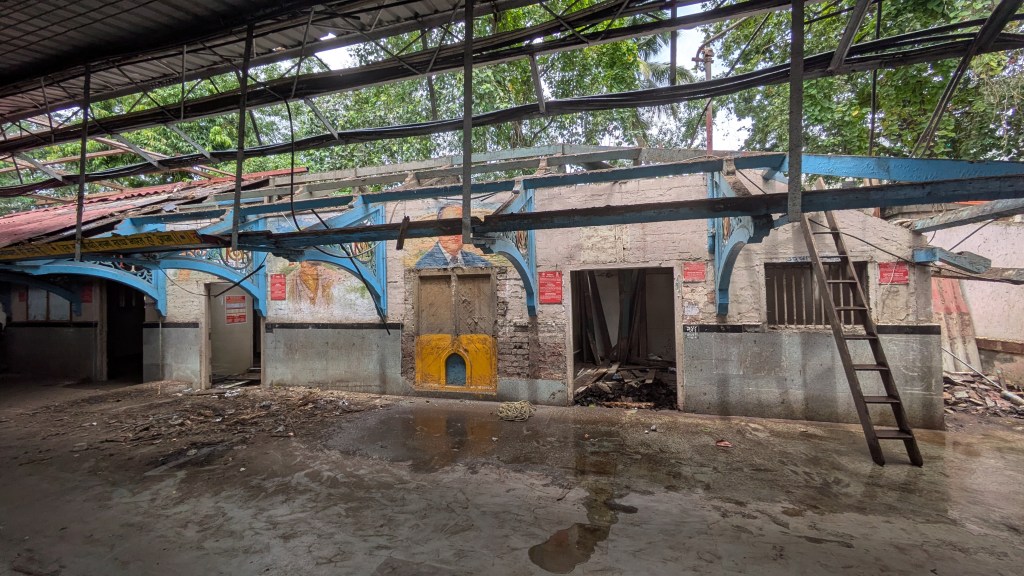
I have appealed for at least some of these brackets to be carefully removed and preserved — at the CSMT heritage gallery, the outdoor exhibition gully or the National Rail Museum. The Railway Board’s Heritage Directorate has acknowledged the appeal to save the Sion relics, while the Rail Enthusiasts’ Society has extended formidable support to the effort.
This is not the first time I have made such an appeal.
I have been fighting this battle for over three decades now.
My subject is the Great Indian Peninsula Railway — the GIPR — the railway that operated India’s first commercial passenger line between Bombay and Thane in 1853. The extraordinary thing about this railway is that much of its original alignment survives within today’s Mumbai suburban system. The trains have changed, the traction has changed, the stations have changed, and the railway is now Central Railway. But the basic geography of that first line remains remarkably alive. The relics here talk to tell the story of the first railway line which can be elaborately read in my first book Halt Station India, The Dramatic Tale of the Nation’s First Rail Lines.
Scattered along it are the last physical witnesses to that beginning.
Some are substantial structures. Others are tiny pieces of iron.
To most people, an old bracket may look like scrap metal. To me, a GIPR bracket carrying the company’s distinctive markings is a piece of the birth certificate of Indian Railways.
That is why the dismantling of the old Sion station structure now worries me deeply.
Deja Vu
We have been here before
In 2017, when redevelopment was taking place at Bhandup, I similarly reported the demolition of the old Bhandup station hut along with its wrought-iron brackets bearing the GIPR logo. Bhandup was not just any suburban station. It was similarly one of the stations on the original Bombay–Thane line, and the first passenger train had made a watering halt there.
At Mumbra, demolition of the old hut in the east, along with brackets revealed another extraordinary survivor — a Victorian-era Tucker & Reeves wall safe embedded in the old booking office. There were efforts to save them, but not for long. All the relics may not have survived, but the discovery demonstrated precisely why demolition of old railway structures needs to be approached with an archaeological eye.
I wrote about both cases and pushed for the relics to be saved.
The result was encouraging. Central Railway decided to preserve the Bhandup GIPR brackets and the Mumbra safe, eventually moving them to the heritage gallery at CSMT. I don’t if they are still there, but those brackets and the safe were at the CSMT heritage museum for some days because somebody stopped the demolition process long enough to ask a simple question:
What are we throwing away?
That question has followed me ever since my school days, when I discovered that the railways I have been travelling on (between my home and school- Kurla & Matunga) is a part of India’s first line and the relics here are the central pieces of India’s railway heritage story.
I have repeatedly documented the surviving fragments of the GIPR — from old railway lamps and safes to GIPR plaques, electric-mast markings, signal structures, old tiles, stonework and roof brackets. Some were rescued. Some were documented. Some were lost.
I have learnt the hard way that heritage disappears piece by piece, project by project, work order by work order.
Kalyan provided another painful reminder. The station’s arched roof went in 2022. A year earlier in 2021, a roughly 168-year-old GIPR-era bridge near Shahad was dismantled and replaced because its steel structure had become dangerously corroded. I understand completely that railway infrastructure has to remain safe. But when an original railway structure has to go, there should be a parallel obligation to document it properly and preserve representative components wherever possible.
Byculla, meanwhile, shows us what is possible when the approach is different. Byculla has an extraordinary place in railway history. The first railway passed through the area, and the station precinct is associated with the earliest years of the Bombay–Thane railway. During its restoration, original features were painstakingly identified and restored in the west side. That is the lesson. Modernisation and heritage conservation do not have to be enemies. The railway can add tracks and still save a bracket. It can demolish an unsafe structure and still retain a representative section. It can replace a bridge and still preserve a girder, plate, maker’s mark or other historically significant component. What is required is awareness before the excavator arrives.
Sion is particularly important
Sion is not an arbitrary railway location. The first sod (the foundation stone) for the GIPR line was ceremoniously turned near Sion in 1850 (31 October). The Indian Railways itself records this association, noting that the first sod for the GIP line from Bombay to Kalyan was turned at a place near Sion.
The first railway line subsequently ran through this landscape, linking Bombay with Thane and eventually becoming the foundation of not just the enormous Central Railway suburban system that exists today, but Indian Railways as a whole.
So when the old Sion railway structure carrying GIPR imprints disappears in August 2026, it is not simply an old building being demolished, but a fragment of the physical landscape associated with the birth of Indian Railways is disappearing.
And this time there is an important difference. The Railway Board’s Heritage Directorate has acknowledged the appeal to save the Sion brackets. That acknowledgment matters.
It means the issue has reached precisely the part of the railway establishment that exists to recognise and protect such history.
The Rail Enthusiasts’ Society has also extended formidable support to the effort. It has also acknowledged that these are not merely objects of nostalgia but tangible pieces of India’s industrial history. There is therefore an opportunity to turn an appeal into action.
We cannot save everything. But we can save something. I have never argued that every old railway object must remain exactly where it stands.
That would be unrealistic. Mumbai’s suburban railway is a living, heavily congested system. It carries millions of passengers and has to expand. Tracks have to be added, bridges rebuilt, stations remodelled and obsolete structures removed. I understand that better than most. Safety is paramount.
But I also believe that development cannot be allowed to erase memory.
The answer is documentation and selective preservation. Put it somewhere where the next generation can see it, the central pieces of India’s industrial heritage.
The CSMT heritage gallery itself is proof that this can work. I had been involved in originally setting it up years ago, listing and taking old relics there. These objects tell a story that no textbook can tell quite as powerfully.
A child looking at a GIPR relic in a museum can understand that this was once physically attached to a railway building through which the earliest trains of India passed. That is living history. Mumbai is ground zero of Indian railway history. That is the reason I keep returning to this subject.
We need a systematic GIPR heritage programme for Mumbai, start with a baisc plaque at Mumbai CSMT, acknowledging it’s role. I have been arguing for this for years.
A proper documentation and inventory should identify the surviving structures and movable relics along the original GIPR alignment — from CSMT and Byculla through Sion, Bhandup and Thane and onwards to the later extensions towards Kalyan and beyond. Every surviving relic should be photographed, mapped, catalogued and graded. Those of exceptional significance should be protected in situ wherever possible. Those that cannot remain should be transferred to a museum or heritage gallery. And demolition proposals affecting known GIPR structures should automatically trigger a heritage review before work begins.
This is not about stopping the railway. It is about making the railway remember itself.
Sion gives us one more chance
I have seen too many of these pieces disappear. I have watched old railway fabric become debris. I have written about it, photographed it, argued about it, appealed to railway officials and, sometimes, succeeded in getting something saved. Sometimes I have failed.
I am therefore making this appeal once again..For the generations that will one day ask- Where did India’s railway begin — and what remains of it today?


Great,continue your efforts
[…] is now some good news from Sion, Mumbai. Following the appeal to save the historic GIPR relics, 18 cast GIPR signs/signage have been removed from the old Sion […]