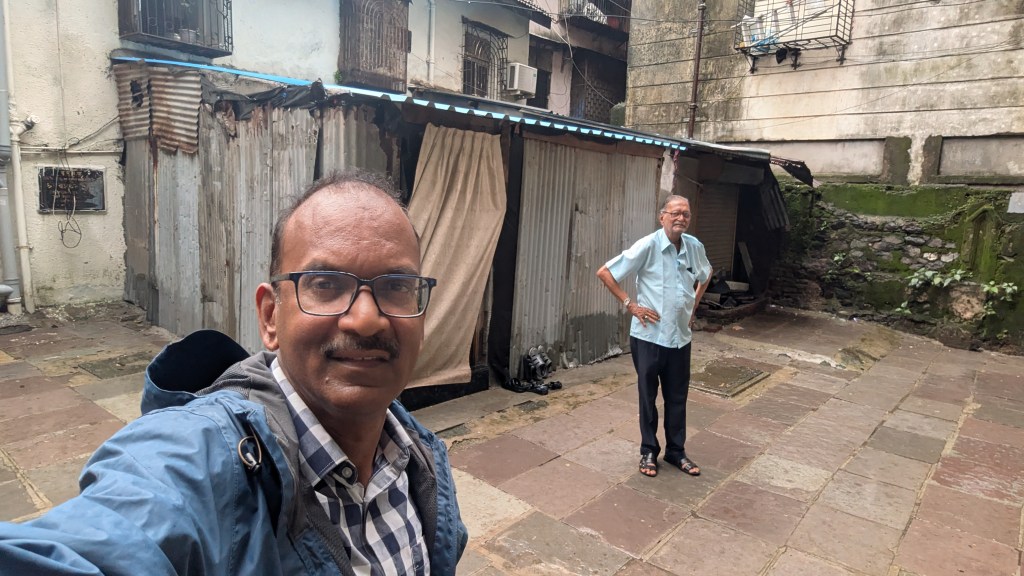
Rafique sir walks the streets of Mazgaon like a king. He has a story on its every corner, every building, every face we met. What was meant to be a casual visit after a long gap to his humble residence at the Khan Building complex at Mazgaon in Mumbai the other day turned out into an unplanned but engrossing heritage walk.
On a July rainy day, as I walked up the first floor, he was on the phone standing in the corridor near the window giving an interview to a journalist…network issue hai andar. You go and sit. I will finish the call and come, he said.
As I entered his home, it still remained full of books just like last time. The only visible no-book things were two plastic chairs for guests, a bed and a wash basin. A minimalist to the core lifestyle, I must say.
Cupboards, shelves, cabinets, storage containers, attic and even the kitchen platform, all had just books, books and more books. Last time (a few years ago), there were many more, this time it looked like a scaled-down version, but the room still looked full.
“This is nothing. I had many, many more. I gave them away to friends. These are the basic ones now,” is what he said of his book full of house as he entered the room.
He went on to explain me the various books, his favourites among them, his readings and like always, his fascinating nuggets.
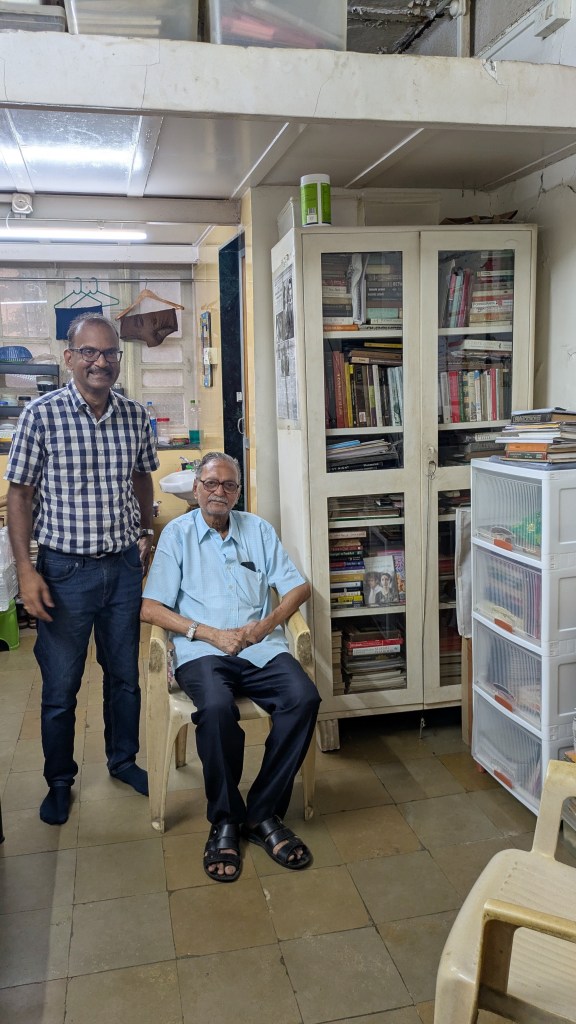
“Wait, chai peete hai,”and he asked his attendant to get two cups of Irani chai. “What is happening with the railways? Have the railways still kept their old magazines? In the olden days, the glorious railway companies like the Great Indian Peninsula Railway (GIPR), the Bombay Baroda and Central India Railway (BB&CIR) always had their own magazines. They were a treasure. Even the Bombay Port Trust had one and I have a few copies here with me,” he said.
Just a day before I met Rafique, I had been documenting and digitising one of Western Railway’s 1923 magazines (BB&CI Railway). I showed him the pictures. His eyes lit up as he gazed at the digitised pictures in my phone and was ecstatic. “What is the oldest one they would have? What year, I mean? he queried. “About the first world war time of 1916, I replied.
“I just want to see it once,” he said and we planned up a journey to the Western Railway head office soon.
Besides books, the walls on his house had pictures of him at various iconic locations, his doctors’ prescriptions, medication and his diet chart. One picture behind the door looked like a fortification as I looked at it closely. “That is Vijaydurg Fort. My native place. I have not been there in many years now. The picture always reminds me of the place,” he said nostalgically. The fort is located in Vijaydurg, in Sindhudurg district of Maharashtra.
After more tete-a-tete over tea for some time, he said, “Let’s go for a walk. Now that you are here, I want to show you around. Lots of things.”
As we stepped out of his room, two fruit sellers climbed up. “Peru hai? he promptly asked. “No,” they said, “baaki sab phal hai.”
“Jaane do, phir,” said Rafique and we stepped down.
As we descended the wooden staircase, I spotted a few cats in the corridor on the ground floor and pointed towards them. Before I could complete my sentence, Rafique said, “Hah! Mazgaon is full of cats. I’ll take you to a lady who has kept about 28 cats as pets just around the corner. Follow me.”
As we stepped down, Rafique began revealing the hidden stories behind every corner of the place. “The trains when they came in the 1850s were called the iron horse and the logo of the Bombay Port Trust too once had a horse on it and here it is. Look closely,” he pointed out to the fascinating find. It had been drizzling and by the time, we were at the corner of the Khan building moving on Hospital Lane, it turned into a proper rain. I said I will go back and get him an umbrella and even offered my jacket. But he was unfazed. “Colony mein hi hoon, chhata nahi chahiye…tu yeh building dekh,” he pointed in the other direction. As always walking inside the Mazgaon colony made him feel at home.
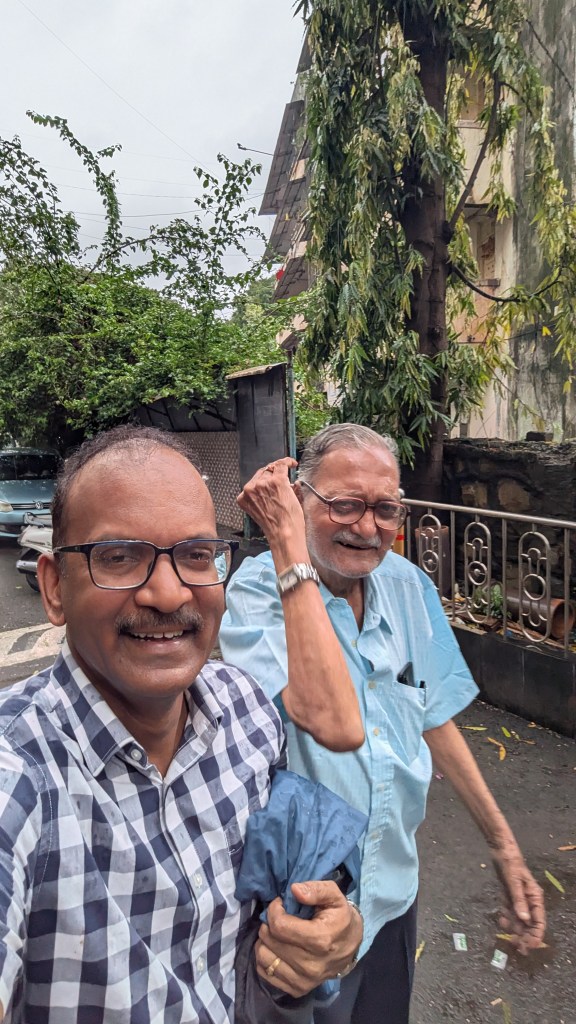
As we walked ahead, he greeted people on the way, we peeped into the house of a lady with 28 cats, further ahead showing me a piece of land that once belonged to the Great Indian Peninsula Railway (GIPR) now used to house a few buildings. Another remarkable relic was the old Gloria Church cross, which once stood on the site now occupied by Anderson’s House, moved here on 29 May 1926. The Bombay Port Trust provided the land, while the public funded its re-erection through subscriptions.
We then move to Bob’s bungalow, a stone and masonry structure with unique stone steps on the approach, wooden staircases with balustrade. “This structure has been built in what was then described as the Mediterranean architecture. Just go back and see that the building has an outhouse as well,” he explained.
We moved past the Coronation building, named so because it was built during the Coronation of King George V and Queen Mary, when they visited Bombay in 1911 and went to Delhi by the GIP Railway Royal train. It was a big event in the city, and this building still celebrates that.
As we entered D’Lima Street, I asked him what was the unique structure that looked more like a workshop. “Well, this is the back side. You will be excited how remarkable the building is from the other side, Chal,” We go inside to find a sprawling two storey bungalow which has retained all its heritage characteristics. It is a 146-year-old Club of St Anthony’s (Deussua). Records state that it is a Goan community institution associated with Deussua village, spread across 10,736 sq-feet, with eight airy dormitories, six family rooms, three toilets, three bathrooms and a kitchen. Traditionally providing affordable accommodation to Goan migrants working in Mumbai, each member pays a fee every month.
I walked out thrilled. So much heritage and so many stories in just one lane with Rafique, imagine. And we had not even been to the popular Mazgaon heritage sites like Mhatarpacdy with its charming East Indian bungalows and all yet.
As I walked out with him back on the D’Lima Street thinking all this, he breaks my thought chain. “Ye dekh. Go inside here. It is the best bakery in town, and I enter another narrow lane to find the aroma of freshly baked bread slices, and it is the famous Wibs Bakery, wow!”
I had been getting calls from office and had to rush, but not before having a cup of tea and more chats at the famous Pine Restaurant at the corner. “Come again and we shall explore more,” he said as we parted, with him giving me, albeit small but one of my life’s most memorable heritage walks at Mazgaon.

