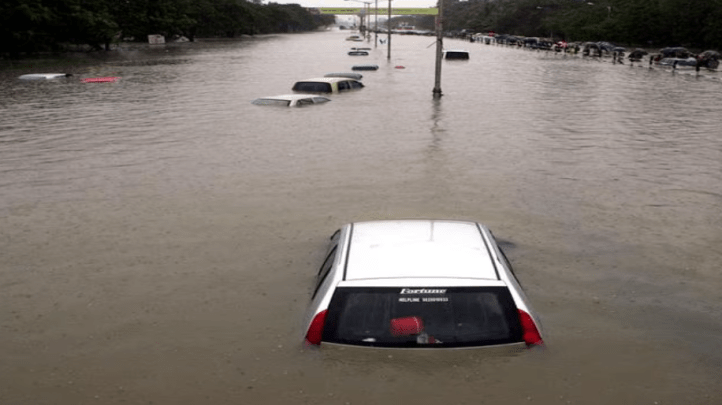
The Mumbai inundation. Pic by former colleague Vijayanand Gupta
21 years ago. 2005 was a defining year for Mumbai’s media. It was the battle of the biggies who were set to launch their Mumbai editions starting with the Hindustan Times, DNA and Mumbai Mirror. I had joined the Hindustan Times as their Mumbai correspondent covering transport. We had been taken in much earlier and started filing stories with its Mumbai bureau chief Sujata Anandan much before its formal Mumbai launch.
Initially, we sat at the bureau in LIC Building opposite Churchgate station, subsequently moving to Mahalaxmi Engineering Estate behind Mahim Church. It was our new, state-of-the-art newsroom.
July was the month. The battle of hoardings, kiosks and massive outdoor media campaigns had already begun before and during the launch and it was a sort of a watershed moment for Mumbai’s media. Every development and news story was important.
And then, it rained. Like nothing before.
Mumbai was struck by a catastrophic deluge, recording an unprecedented 944 mm (37 inches) of rainfall in 24 hours, the highest ever in the city’s history, paralyzing it like never before.
I was in the newsroom at Mahim throughout the day when that happened with a continuous inflow of updates and as the night fell, we realised we had nowhere to go. Many MTNL landlines were down, but I still received a few frantic calls from my family. Somehow, they had managed to get through to me. They just wanted to know if I was safe. My wife and daughter had been safe as they were at Bhandup where the situation remained better. It was worse at Kurla where my parents were. My dad had been bed-ridden and our building at Kurla east had been inundated with water. I had to be there somehow but was next to impossible. I had to sleepover at the office. It was a night filled of worries and at the same time, a number of things were happening in the city. Cars stranded on flyovers, people trapped amid rising water levels, vehicles getting washed away and in fact floodwaters rising so high that local trains and buses were almost completely submerged, leaving only their roofs visible. It was something like the Hollywood sci-fi disaster film The Day After Tomorrow, released just a year ago in 2004, but in real life. There were horrible stories of people getting stuck in cars and suffocating to death. Every hour there was some grim update. It was a busy, busy news day and night as it poured. We were up throughout the night.
We, in the newsroom, then decided to have some positivity. I was assigned a sunshine story. New life amid this chaos. I was at Wadia Children’s Hospital at Parel with a photojournalist in tow to document the newborn on this day. The staff and nurses had already had a harrowing time due to the rains and just like us they too had stayed back. They reluctantly agreed and we got a good story. The parents were happy. I don’t remember the faces, but that was one happy story in those harrowing hours.
The relentless rain showed no signs of ease and my worries about my family stranded back at Kurla was topmost on my mind. Finally in the afternoon, I decided to step out of the office. But there were no trains, no cab and no buses. Kurla was not far from Mahim. I decided to walk.
Holding umbrella in one hand, wading through water, my thoughts with the family, I walked past the BKC witnessing a deluge like never before. Past MTNL Office, I reached the LBS Road. There was so much water that there was no way one could walk it up. The Mithi river, unknown to many till then, had swollen and gobbled up the entire Kurla area. I climbed onto a crowded bus, which took me some distance till the bus depot.
At the Kalpana junction, the upcoming and incomplete SCLR bridge pillars were looking somewhat like abandoned structures standing tall amid ripples of water. Walking past I reached Kurla station, which had turned into a refuge area – the booking office, the platforms etc – not just for commuters and all those who had got stranded, but also for local residents because the station had power supply, food at the stalls and platforms above the water levels.
Abandoned local train EMUs (those were the DC era days with those yellow and rust brown trains) stood across platforms with people sleeping inside them, just waiting for them to start. It was a scene like never before.
I managed to crossover to the east and the waterlogging situation was worse there. I could witness people fallen in drains due to one mis-step, shops completely inundated with water, many trying to take out their stocks to dry up. At Nehru Nagar signal, young volunteers had tied ropes to lamp posts across the length of the road so one could hold it and wade through water without falling into any pit or manhole. Holding it with a firm grip (I can still feel the hold), I finally reached my building. Entering the building was another challenge as the water had entered the ground floor flats and the water reaching halfway to the first floor. We used to be on the second floor. My mom and sister had been waiting and father, confined to his bed, anxiously awaiting me. They just wanted to know I was safe. The 7-km journey remained was one of my most unforgettable memories of the 26 July deluge. Dad passed away just a month later, making that anxious homecoming one of the last precious memories I have of him.
The deluge of 26 July 2005 changed Mumbai forever. These memories never left me. 21 years now. It feels like yesterday.

